

Skip to content

A Kizuki book

The Borrowed Self

Why you live by rules you never chose, and how to give them back

The cover: a paper coat on a hanger, a little too big for it, with a blank luggage tag.

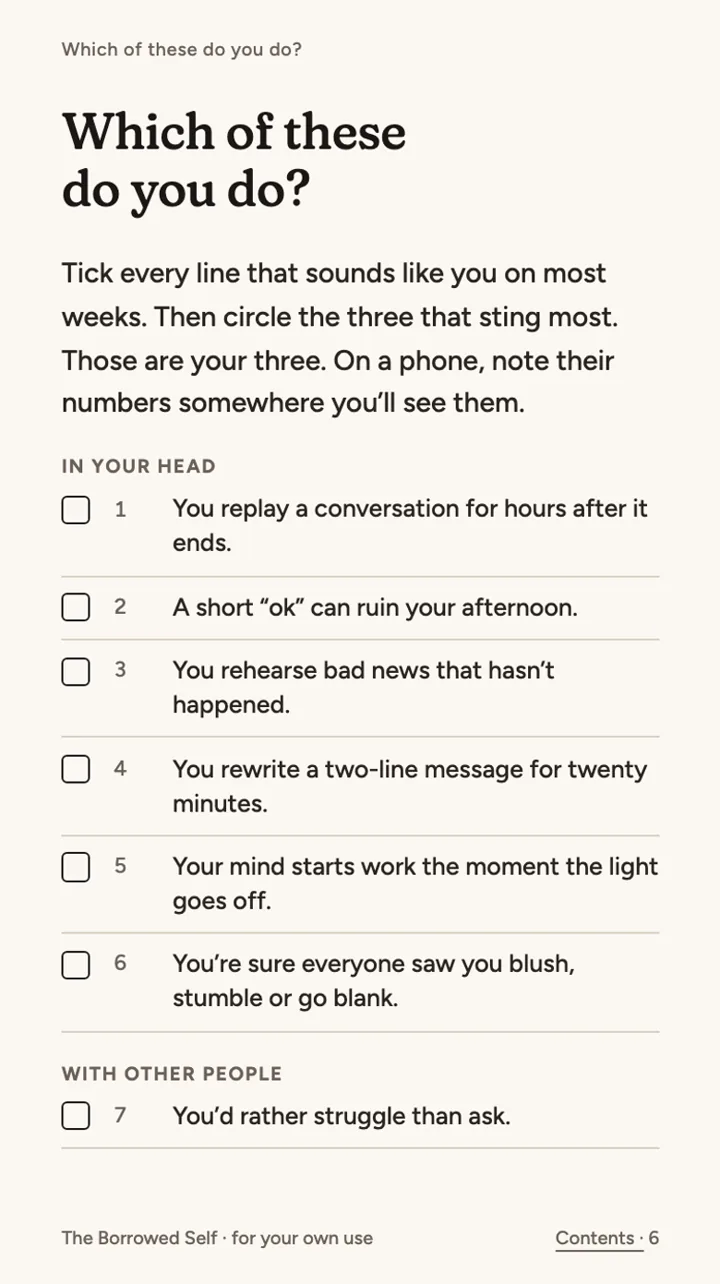
You replay a conversation for hours after it ends.

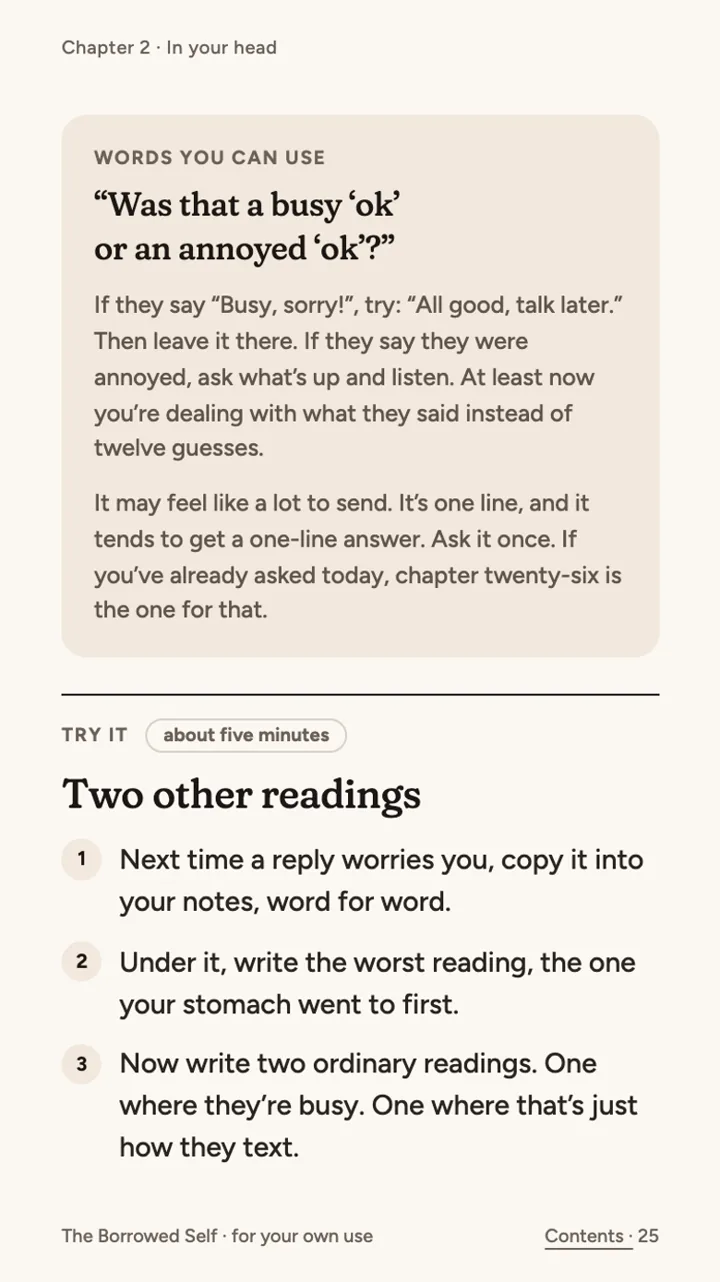
A short “ok” can ruin your afternoon.

“Fine” comes out before they finish asking.

You’re always the one who messages first.

Each of these is a rule you picked up somewhere. This book names thirty of them. For each one it shows what the rule protects, what it costs you now, and one move to try the next time it runs.

  • 30 short chapters
  • A few minutes each
  • Exact words to say
  • A 30-day plan
  • Phone and print editions

Read chapter one free ↓

Which of these do you do?

Tick the ones that sound like you. Nothing you tick leaves this phone.

See inside

Two PDFs: one shaped for your phone, one A5 to print or use on an iPad.

Read chapter one free

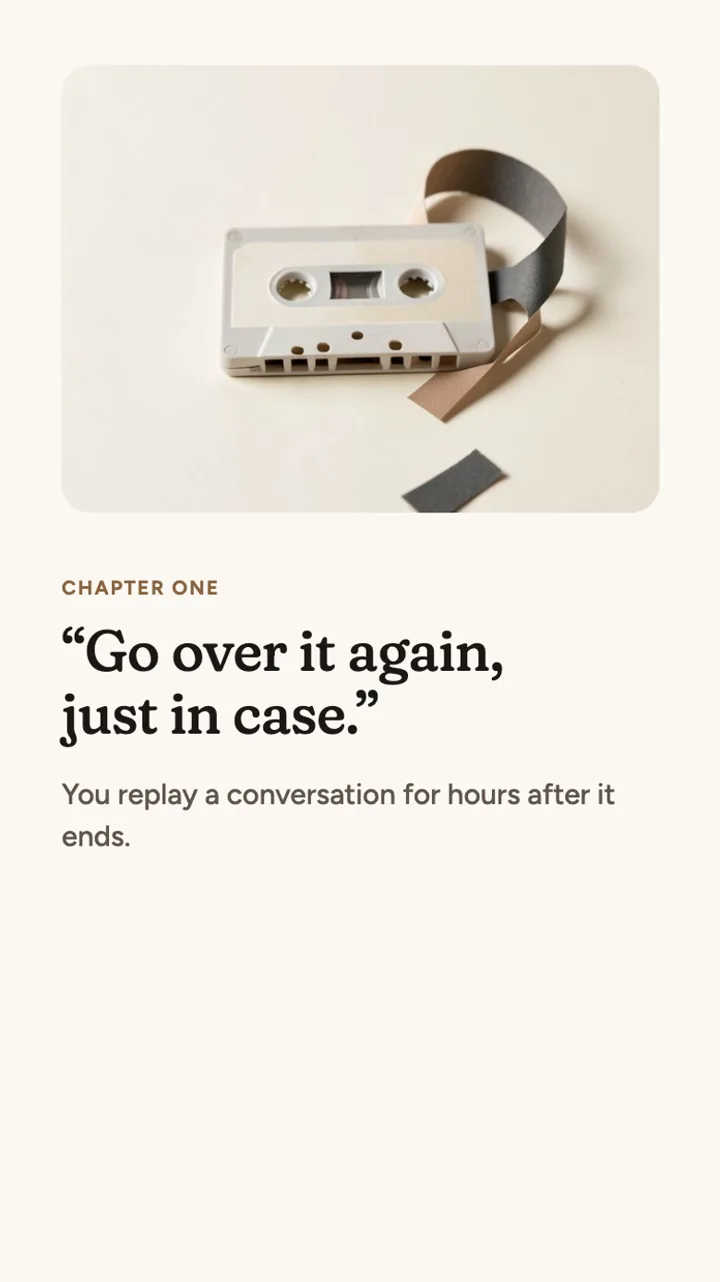
A paper cassette tape with its loop of tape pulled out in a loose tangle.

Chapter one

“Go over it again, just in case.”

You replay a conversation for hours after it ends.

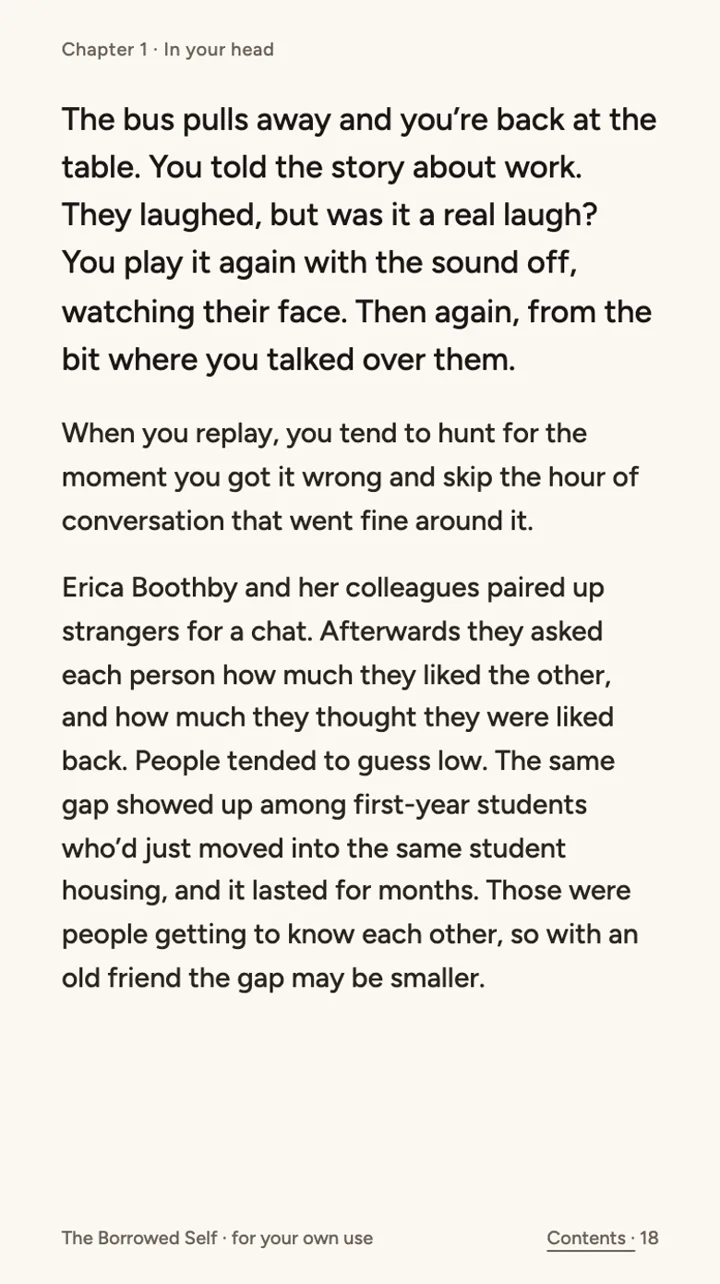
The bus pulls away and you’re back at the table. You told the story about work. They laughed, but was it a real laugh? You play it again with the sound off, watching their face. Then again, from the bit where you talked over them.

When you replay, you tend to hunt for the moment you got it wrong and skip the hour of conversation that went fine around it.

Erica Boothby and her colleagues paired up strangers for a chat. Afterwards they asked each person how much they liked the other, and how much they thought they were liked back. People tended to guess low. The same gap showed up among first-year students who’d just moved into the same student housing, and it lasted for months. Those were people getting to know each other, so with an old friend the gap may be smaller.

What it protects

If you find the mistake first, nobody can surprise you with it later. Replaying is a way of staying ready.

What it costs

The evening can end hours later for you than for everyone else. The version you keep tends to be the harshest one.

The next time it runs

Catch it
The replay tends to start in a gap: the walk home, the bus, the dark.
Name it
“I’m checking for mistakes again.”
Choose
Let the replay run once. Then ask yourself what went fine.

Try it

about ten minutes

The rest of the tape

  1. 1.Pick a conversation from this week that you keep going back to.
  2. 2.Write the part you replay in one line.
  3. 3.Before you go on, guess, zero to ten, how much they enjoyed talking to you. Write it down.
  4. 4.Now write two things that went fine, like a second question they asked or a laugh you didn’t plan. If you can only find one, write that, and what they did straight after the part you replay.
  5. 5.Look at your guess again. Would you move it? Write the new number beside the old one, even if it’s the same.

For example

The part I replay: I talked about my job for too long. What went fine: she asked where I worked before, and she stayed for another drink. My guess: three. After the list: four. Not much of a move. I still wince at the job bit.

Your plan

When I catch myself replaying a conversation, I will

Worth thinking about

  • What are you hoping the replay will find?
  • If a friend told you this story about themselves, which part would you notice first?

Next: one short “ok”, and how much of what you read into it is yours.

Source: Boothby, E. J., Cooney, G., Sandstrom, G. M., & Clark, M. S. (2018). The liking gap in conversations: Do people like us more than we think? Psychological Science, 29(11), 1742–1756.

That’s one of thirty.

What’s inside

  1. Part one

    In your head

    After the moment is over.

    1. 1Go over it again, just in case.
    2. 2Read the reply for clues.
    3. 3Expect the worst, so it can’t surprise you.
    4. 4Don’t send it until it’s perfect.
    5. 5Stay up and solve it.
    6. 6Everyone noticed.
  2. Part two

    With other people

    Staying easy to like.

    1. 7Don’t be a bother.
    2. 8Say yes, sort it out later.
    3. 9Say sorry first.
    4. 10Don’t take too much.
    5. 11Go first, or they’ll forget you.
    6. 12Agree. It’s easier.
  3. Part three

    In your body

    When your body gets there first.

    1. 13Don’t cry. Not here.
    2. 14Don’t let them see your face.
    3. 15Keep a lid on it.
    4. 16If your heart races, something’s wrong.
    5. 17Carry it so nobody else has to.
    6. 18Freeze until it passes.
  4. Part four

    From home

    Through the front door.

    1. 19Check the mood before you walk in.
    2. 20Keep everyone okay.
    3. 21Say you’re fine.
    4. 22Be the easy one.
    5. 23Don’t need anyone.
    6. 24Stay on guard at home.
  5. Part five

    In closeness

    When someone gets near.

    1. 25Leave before they can.
    2. 26Ask again, just to be sure.
    3. 27Go quiet. It’s safer.
    4. 28Keep count, so you know where you stand.
    5. 29Don’t show them the mess.
    6. 30Be who they need.
  • The check: which of these do you do?
  • Three moves for every rule
  • Your month with three rules
  • Where the studies are: every study, with a link

For you if you know the rule before you know why you did it, and you want something to try instead of a lecture.

Not for a crisis, or a diagnosis. If things feel like too much, these can help: Lifeline 13 11 14 (Australia) · Kids Helpline 1800 55 1800 (up to twenty-five) · 988 (US) · Samaritans 116 123 (UK) · findahelpline.com anywhere else.

Questions

Do I need to take the quiz first?

No. The book works on its own. The free quiz is there if you want a reading of your five traits as well.

Is this therapy?

No. It’s a book of everyday things to try on your own. If you need more support, the lines above can help.

Is it a subscription?

No. You pay once and nothing renews.

What do I get?

Two PDFs, yours to keep: one shaped for your phone, one A5 to print or use on an iPad.

What if it doesn’t fit me?

Read chapter one first. If it doesn’t sound like you, don’t buy it. Because it’s a digital book, there are no refunds for a change of mind. If something’s wrong with it, we’ll fix it or refund you.

Where do the ideas come from?

About half the chapters name a published study, with who did it and what they found, and every source is listed at the back with a link. The rest are said as experience, plainly.

Curious about your five traits? Take the free Kizuki quiz.